
Your property is to be sold at auction, in a foreclosure or a court-ordered liquidation, and the announced reserve price (mise à prix) seems far below what it is worth. Is that normal, who decides the amount, and can a valuation change it? A decision of the Orléans Court of Appeal of 28 May 2020 answers these three questions, and recalls in passing that time rarely works in favour of an owner who does not react. I have already covered this subject from the angle of prevention in avoiding property foreclosure in France.
The facts: seventeen years between the liquidation and the sale
A business owner was placed in court-ordered liquidation on 5 July 2002. Family properties secured his debts. On 2 March 2004, the proceedings were extended to those properties. It was not until 17 May 2019 that the supervising judge (juge-commissaire) ordered their sale at public auction, seventeen years after the proceedings were opened.
The Court noted that the owners “never cooperated with the officers of the proceedings” and that they had “shown their obstruction by refusing to let a bailiff visit the properties” to describe them for the sale. Their only initiative before the Court was to produce a property estimate to contest the reserve price.
Main residence: a protection that is not presumed
The Court recalled that the main residence of a sole trader has been exempt from seizure by professional creditors as of right since the law of 6 August 2015 (French Commercial Code, article L. 526-1). But this protection applies only to debts arising after the law came into force, and for other properties a notarised declaration of exemption from seizure remains necessary. Here, the Court found that the appellants “neither showed nor even alleged that they had made a declaration of exemption from seizure”.
Advice taken from a notaire (French civil-law notary) or a lawyer before starting a business makes these mechanisms known. When the business runs into difficulty, it is still worth seeking advice: solutions exist as long as dialogue with the liquidator remains possible.
Lost time has a cost
Between 2002 and 2019, the market for existing homes rose strongly, particularly in the first half of the 2000s. A private sale started when the proceedings were opened, or even a few years later, would probably have cleared the debts and preserved some capital.
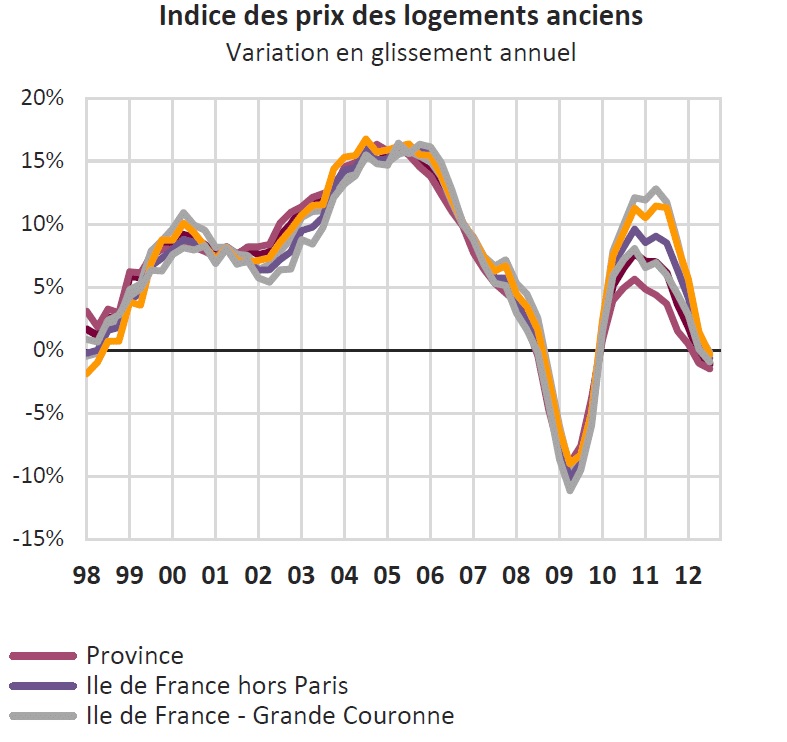
In practice, liquidators frequently allow a period, often of around a year, to attempt a private sale before applying for a forced sale. That period is adapted to each situation. It does assume, however, that the debtor cooperates: access to the property, handover of documents, marketing at a price consistent with the market.
Who sets the reserve price?
In a court-ordered liquidation, properties are sold following the forms of a property foreclosure (saisie immobilière), but it is the supervising judge who sets the reserve price and the essential conditions of the sale, after hearing the debtor and the liquidator (Commercial Code, article L. 642-18). In an ordinary foreclosure, the reserve price is set by the pursuing creditor; if it is manifestly inadequate, the debtor can apply to the judge for a reserve price “consistent with the market value of the property and market conditions” (Code of Civil Enforcement Procedures, article L. 322-6).
In both cases, the judge decides. An estimate or a valuation report informs the judge but does not bind them.
Why half the market value can be “right”
An auction is not a private treaty sale. The decision recalls that the reserve price “must be set at an amount attractive enough to draw the largest number of bidders and so allow the bidding to play out”. It is a starting point, not a sale price.
The Court accordingly held that the supervising judge had “rightly set the reserve price at an amount corresponding to about half the market value of the properties”. Three factors explain this position:
- The reserve price is meant to trigger bidding; it does not prejudge the auction price.
- The owners had been given seventeen years, without any cooperation on their part.
- The estimates produced came from sales professionals; an opinion of value does not carry the weight of a valuation report, which justifies and demonstrates the value according to a methodology and engages the liability of its author (Charte de l’expertise en évaluation immobilière, French property valuation charter, 6th edition, Title I, §1.1).
This practice is in line with a custom often cited in court sales: a reserve price not exceeding two-thirds of the appraised value. If two-thirds is a ceiling, half appears as a reasonable norm.
Forced sale and market value: two distinct concepts
Market value assumes proper marketing, between a willing seller and a willing buyer, without compulsion (Charte, Title III, §1.1; EVS 2025, EVS 1). Where the seller is under a time or procedural constraint, one speaks of a forced sale price. The Charte (Title III, §1.12) and the European Valuation Standards 2025 (EVS 1, §6.7) make clear that this is not a separate basis of value but a market value determined under a special assumption: a limited marketing period, and the fact that potential buyers know of the seller’s constraint.
In a report, these two values can be presented side by side. This lets the owner, the liquidator or the judge measure the gap between what the property would be worth on the market and what it will probably fetch at auction.
What the owner can do
The appellants’ only effort was to produce an estimate to contest the reserve price, and the Court took it into account in its reasoning, without changing the amount. The report is therefore useful, but it comes late. Earlier in the proceedings, it serves another purpose:
- to justify to the liquidator or the judge a private sale price consistent with the market;
- to show that a sale is possible within a short period, by setting a price that matches the market;
- to document the condition of the property, its constraints and its strengths, so that a description made by a third party is not the only document on file.
An auction should remain the last resort, when no buyer has come forward despite serious marketing. Selling a property at market price generally takes from a few weeks to a few months, which leaves real room for manoeuvre to anyone who acts in time.
Further reading
The Market value page describes the valuation of a property, including under a forced-sale assumption. Two other articles complete this one: avoiding property foreclosure in France and cancelling a property sale in France for a price far too low.
What next
Do you need a value that will stand up before a notaire, a judge or the tax authorities?
Inheritance, divorce, gift, tax audit, guardianship: I tell you which report you need, in what timeframe and at what price.
Free quote, by email or by phone. No commitment before the quote is accepted. Fees are never linked to the value of the property (Charte de l’expertise, Title I, §2.1).