You bought a new home in France under a tax reduction scheme, and you find that it is hard to let and would resell well below its price. Can the sale be set aside? A ruling of the Paris Court of Appeal of 8 December 2017 (case no. RG 16/05276) says no in a typical case, and reminds buyers that they are expected to inform themselves about the value of the property before signing. The analysis holds for every tax incentive scheme, past or future.
The facts
In 2006, Mr X bought a studio flat and a parking space in SAINT-DENIS-DE-LA-RÉUNION, on Réunion Island, as a “Girardin” investment, for €151,000. He tried to let it, without success. He then tried to resell it, with no better result.
He then sued the developer and sought to have the sale set aside for defective consent, relying in particular on irregular doorstep selling.
The Girardin scheme
The Girardin scheme (article 199 undecies A of the French General Tax Code) gave a tax reduction for the purchase of a new or off-plan home in the French overseas departments and collectivities, on condition that it was let for at least five or six years. Depending on the project, the reduction represented 22 % to 48 % of the purchase price, capped at €2,449 excluding VAT per square metre and spread over five years. Its rental component expired at the end of 2017.
The mechanism carried a structural risk: since the advantage was proportional to the price, nothing encouraged anyone to keep the price down. Some developments were marketed at prices well above local market value, and many buyers discovered on resale that they had paid far more than the property was worth. Where the home found no tenant within the required period, the tax advantage also had to be repaid.
The decision: the buyer should have made enquiries
The Court upheld the first-instance judgment and dismissed Mr X’s claims. It held that the buyer had had every opportunity to enquire about the market value of the property he was buying, so that he could not claim to have noticed his error on the price only when he wanted to resell it.
This solution matches a rule now written into the Civil Code: an error as to value, where a party merely makes an inaccurate economic assessment of the property without being mistaken about its essential qualities, is not a ground for nullity (article 1136). To have a sale set aside, the buyer must establish fraud (dol), that is, manoeuvres or lies that induced consent (article 1137), or an error as to an essential quality. The price alone is not enough.
The checks to make before buying
The Court criticised Mr X for not informing himself. In practice, a few checks would have made it possible to measure the risk:
- The town’s demographics. A growing population supports rental demand; a stable or falling population, combined with abundant new supply, points to vacancy.
- Available supply. The number of comparable homes offered for rent and for sale in the area shows the competition the property will face.
- Prices and rents actually achieved. Rents are tied to the incomes of local households; a projected rent above the market will not be obtained for long.
- Location. A renovated older building in the town centre generally performs better than one new development among many on the outskirts.
Investing in property means, first of all, buying a location. The poorer the location, the higher the risk and the higher the return that should be demanded. With a solid location and a purchase at market price, the risk of a long-term loss remains limited.
The role of an independent opinion
Some sales arguments push for a quick signature and advise against consulting a third party before deciding. That is precisely the signal that should prompt you to take advice: from a notaire (French civil-law notary), a lawyer, or a property valuer independent of the seller and the intermediary.
A valuation report prepared before the purchase compares the asking price, excluding VAT, with the market value of the property, defined as the amount for which it would exchange between a willing seller and a willing buyer after proper marketing (Charte de l’expertise en évaluation immobilière, the French property valuation charter, 6th edition, Title III, § 1.1; EVS 2025, EVS 1). It checks the projected rent against market rental value (Charte, Title III, § 1.4). It engages the liability of its author, which distinguishes it from a desktop opinion of value (Charte, Title I, § 1.1).
The cost of such a report, billed on time spent, is a modest fraction of the price of an investment. In Mr X’s case, an outlay in the order of 1 % of the price would have made it possible to measure the risk before committing €151,000.
What these properties fetch second-hand
As a result of successive Girardin programmes, studio flats in recent residences in SAINT-DENIS-DE-LA-RÉUNION were, at the time this article was first written, on offer for less than €40,000 on the resale market.
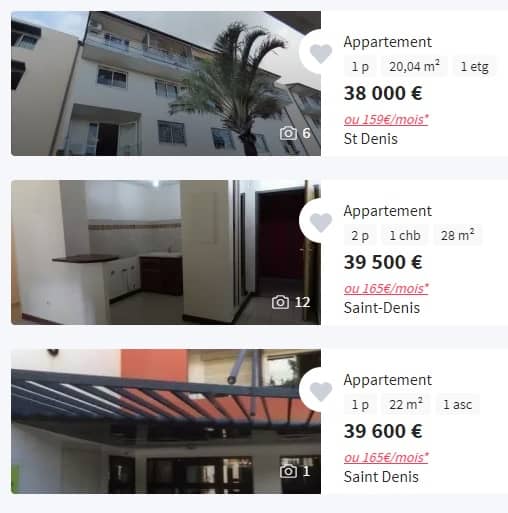
The rental value of these studios ranged between €300 and €400 a month. For a second-hand buyer who manages to let, and provided the co-ownership charges are reasonable, the calculation is as follows: €350 × 12 = €4,200 a year, or a 10.5 % gross yield on €40,000, before conveyancing fees, transfer duties, property tax and income tax on the rents.
That figure sheds light on Mr X’s position. Even assuming his studio has above-average fittings, it seems hard for him to resell it for more than half its purchase price, about €75,000 instead of €151,000. The loss is real, but in the eyes of the court it does not amount to defective consent.
What to remember
A tax advantage does not correct an excessive purchase price; it masks it for the duration of the commitment. Before signing, the buyer has simple ways of informing themselves, and the court expects them to be used. A valuation report, or failing that a consultation with an independent professional, is both a protection before the purchase and a decisive piece of evidence if a dispute arises.
Further reading
The Property loss of value page describes the assessment of a loss caused by an overvalued price. Two other articles deal with the same subject: French property tax incentives in 2025, mainland and overseas and cancelling an off-plan purchase for an overvalued price.
What next
Has your property lost value because of a third party?
Neighbouring construction, hidden defect, wrong floor area, overpayment at purchase: the loss of value and the loss of enjoyment quantified with the method accepted by French courts.
Free quote, by email or by phone. No commitment before the quote is accepted. Fees are never linked to the value of the property (Charte de l’expertise, Title I, §2.1).