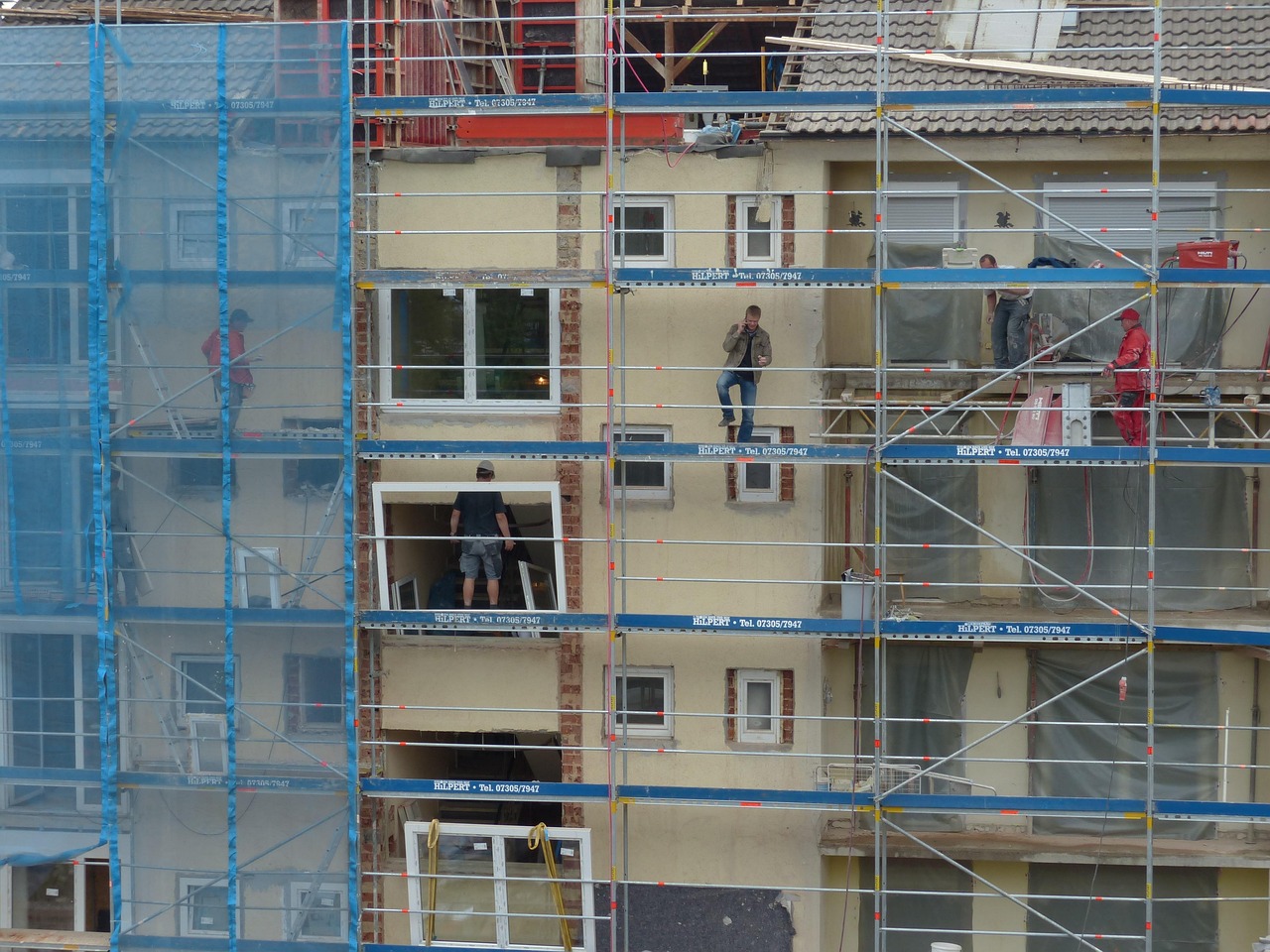
Your co-owned building, or your house, shows defects that appeared after handover. Several firms worked on the site, each with its own insurer, and you do not know on which legal ground to sue nor how to put a figure on the loss. A ruling of the Cour de cassation (the French supreme court for civil and commercial matters), which partly quashes a decision of the Grenoble Court of Appeal of 4 May 2021, sets out in seven points how liability is shared between builders in France and how the judge must assess the damage.
The facts
A hotel and tourist residence had been built and sold off-plan (vente en l’état futur d’achèvement, or VEFA) by an SCI (société civile immobilière, a French property-holding company). Defects appeared. The co-owners’ association (syndicat des copropriétaires) sued the selling SCI, the parties involved in the construction and their insurers. The Court of Appeal made various awards. Several parties appealed to the Cour de cassation.
The seven points of the decision
The seller of a building to be constructed is liable for intermediate defects only on proven fault
The seller of a building to be constructed owes the statutory builders’ warranties (article 1646-1 of the French Civil Code): the ten-year builders’ liability (garantie décennale) for defects that compromise the solidity of the structure or make it unfit for its purpose (article 1792), and the two-year warranty of proper functioning for detachable items of equipment (article 1792-3). Defects that do not reach that level of seriousness, known as intermediate defects, fall under ordinary contractual liability. That liability requires proof of fault. The Cour de cassation censures the Court of Appeal for not having sufficiently established the fault of the selling SCI.
The judge rules only on the claims set out in the operative part of the submissions
On appeal, the court rules only on the claims stated in the operative part of the parties’ written submissions (article 954 of the French Code of Civil Procedure). The Court of Appeal had awarded more than one party had asked for in that operative part. It is censured.
Every award must rest on a stated legal ground
The judge must state the legal basis of the decision (article 12 of the Code of Civil Procedure). Awards for consequential losses, made without saying whether they rested on the ten-year liability or on contractual liability, are quashed.
The insurer held liable in solidum owes cover to its insured
When a liability insurer is held liable in solidum (jointly, for the whole) with its insured, it owes that insured its cover as soon as the insured risk has materialised, within the limits of the policy. The Court of Appeal could not refuse that cover.
The judge cannot refuse to value a loss whose existence has been found
This is a constant principle: a judge who finds that a loss exists in principle cannot refuse to value it on the ground that the evidence is insufficient. The judge must order an investigative measure or assess the amount (article 4 of the Civil Code, which prohibits denial of justice). The Court of Appeal is censured for dismissing a claim after accepting the principle of the damage.
A contractor who contributed to a ten-year defect answers for the whole damage
A builder whose act contributed to a defect of the ten-year kind must compensate the project owner (maître d’ouvrage) for the whole damage. The sharing between co-liable parties then takes place between them, through contribution claims, and cannot be raised against the victim.
The judge cannot ignore a document properly disclosed
The Court of Appeal had stated that an expert report had not been produced, whereas it appeared on the schedule of disclosed documents. The Cour de cassation sanctions this distortion by omission.
What the valuation expert takes from it
Classify each defect before pricing it. The distinction between a ten-year defect, a proper-functioning defect and an intermediate defect determines the legal ground of the claim, the proof required and the insurer that can be called upon. The court-appointed building expert gives an opinion on the nature and origin of the defect. The valuation expert then steps in to measure its consequences on the value and the enjoyment of the property.
Price every head of loss, including consequential ones. Lost rents of a closed tourist residence, loss of value on resale, loss of enjoyment: these losses must be valued head by head, with a stated method and references. The ruling reminds us that the judge cannot merely find a loss without pricing it. A report that provides a reasoned valuation gives the judge the means to decide.
Take account of every document. Earlier expert reports, handover minutes, quotes, exchanges with insurers: the valuation expert examines them all and cites them. An expert report that sets a document aside without explanation weakens the decision that relies on it.
Stay within the terms of the instruction. Just as the judge cannot rule beyond the claims, the expert answers the questions put by the court’s order or by the engagement letter, and flags what falls outside them. The Charte de l’expertise en évaluation immobilière (French property valuation charter), 6th edition, November 2025, Title I, §4.4, reminds us that the court expert respects the adversarial principle and carries out the assignment personally. The Code of Civil Procedure governs court-ordered expert appraisals in articles 232 to 284-1.
How a defect translates into the value of a property
Three situations arise. If the defect can be repaired, the loss of value corresponds in principle to the cost of the works, increased where relevant by the loss of enjoyment during their duration. If the defect leaves a lasting trace (stabilised but visible cracking, a structure repaired using a non-standard technique), a market discount may remain after repair. It is measured by comparison with sound properties. If the defect affects the operation of an income-producing property, as here a tourist residence, the loss of income is added and is calculated over the period of unavailability, from the rents or the trading accounts. In all three cases, the report clearly separates the repair cost, the residual loss of value and the lost earnings, so that the judge can attach each head to its legal ground.
Scope of the decision
The ruling creates no new rule. It restates, with unusual density, how the statutory builders’ warranties fit with ordinary contractual liability, the limits of the appeal court’s role and the duty to value a loss once it has been recognised. For project owners and co-ownerships, it confirms that the quality of the evidence file and the precision of the figures determine the outcome.
Further reading
The Property loss of value page describes the valuation of a loss of value or a loss of enjoyment, its timescale and its fee. Two articles complement this one: defective septic system and hidden defect and damp wall: what loss of value.
What next
Has your property lost value because of a third party?
Neighbouring construction, hidden defect, wrong floor area, overpayment at purchase: the loss of value and the loss of enjoyment quantified with the method accepted by French courts.
Free quote, by email or by phone. No commitment before the quote is accepted. Fees are never linked to the value of the property (Charte de l’expertise, Title I, §2.1).